


Konserverade mossväggar vs levande väggar
Arkitektens kompletta guide till specifikation, prestanda och ROI. Teknisk data, kostnadsanalys och certifieringsvägar. Ingen marknadsföringssnack.
Innehållsförteckning
Vad är mossväggar?
Konserverade mossväggar är paneler av naturlig mossa som har behandlats genom en glyceriniseringsprocess. Mossan skördas när den är som fullmogen, sedan nedsänks den i en växtbaserad glycerinlösning som ersätter det naturliga fuktinnehållet. Resultatet: mossa som behåller sin naturliga färg, textur och mjukhet på obestämd tid, utan behov av varken vatten, ljus eller underhåll.
Konserveringsprocessen använder inga giftiga kemikalier. Glycerinet är livsmedelsklassat, växtbaserat och biologiskt nedbrytbart. När mossan väl är konserverad upphör all biologisk aktivitet. Den växer inte, släpper inte sporer och förmultnar inte.
Typer av konserverad mossa
Inte all bevarad mossa är likadan. Varje typ erbjuder distinkta texturer, akustiska egenskaper och visuella effekter:
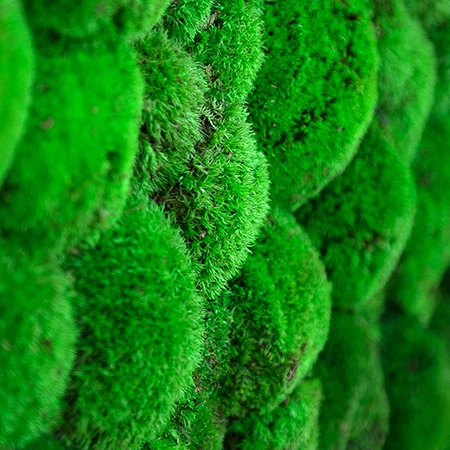
Runda, kuddliknande kuddar med en rik, tredimensionell textur. Den mest effektiva akustikabsorbenten: NRC 0,73, testad enligt ISO 11654:1997. Brandklass B-S2-d0 (EN 13501-1). Det premiumvalet för akustisk prestanda i kommersiella interiörer.
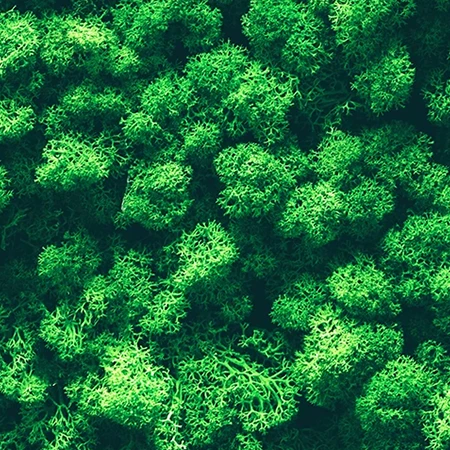
Mjuk, svampig textur finns i flera färger (naturligt grön, arktisk vit, djupgrön, specialfärgad). Lätt, mångsidig och kostnadseffektiv. Idealisk för stor yttäckning, logotyper och dekorativa paneler.
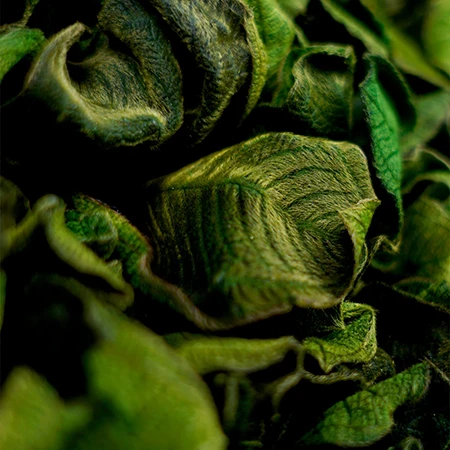
Platt, bladliknande textur som skapar ett frodigt, trädgårdsliknande utseende. Tät täckning med en förfinad, skiktad estetik. Används ofta i projekt inom hotell- och restaurangbranschen samt i exklusiva bostadsprojekt.
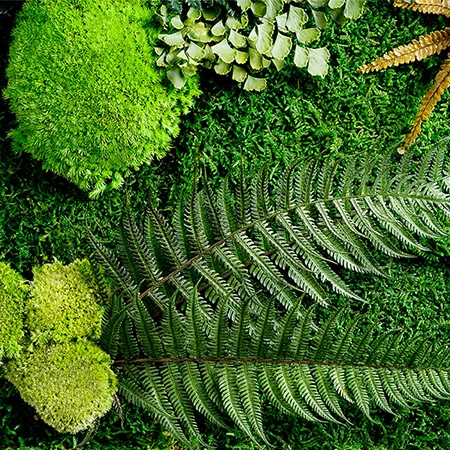
Naturligt, vilt utseende som kombinerar flera mossarter och texturer. Skapar en organisk, skogsaktig effekt. Används för installationer som strävar efter ett naturalistiskt snarare än ett minutiöst skött utseende.

Hur länge håller bevarade mossväggar?
Med korrekt inomhusinstallation (skyddad från direkt solljus och överdriven fuktighet) bibehåller mossväggar sitt utseende i 10 år eller mer utan någon åtgärd. Många installationer förblir oförändrade efter 15+ år.
Garantiperioden för professionella konserverade mosspaneler är vanligtvis 10 år.
Vad är levande gröna väggar?
Gröna väggar (även kallade vertikala trädgårdar eller gröna fasader) är system av levande växter som växer vertikalt på en väggstruktur. De kräver aktiv infrastruktur för att upprätthålla växterna: bevattning, dränering, växtmedium och ofta kompletterande belysning.
Infrastrukturkrav
En levande vägg är inte en produkt. Det är ett system.
En typisk installation kräver:
- Bevattningssystem Automatisk bevattning med timers, pumpar och distributionsledningar. Måste anslutas till byggnadens vattenförsörjning och avlopp.
- Växtmedium Jord, filt eller hydroponiskt substrat för att stödja växtrötter.
- Dränering: För att förhindra vattenskador på väggen bakom installationen.
- Extraljus: Många inomhusinstallationer kräver växtbelysning, särskilt i utrymmen utan direkt naturligt ljus.
- Strukturellt stöd Levande väggar väger, när de är mättade, 30-80 kg/m², vilket kräver strukturell utvärdering och eventuell förstärkning.
Dolda kostnader för levande väggar
Inköpspriset för en levande vägg är bara början. Den verkliga kostnaden inkluderar löpande underhåll av växter (besök av professionell hortonom för beskärning, gödsling, skadedjursbekämpning och växtbyte), växtbyte (10-20% årlig dödlighet), vattenförbrukning, energi för växtbelysning, systemfel (pumpfel, igensatta bevattningsledningar, sensorfel) och risk för driftstopp.
Jämförelse sida vid sida
Underhåll
| Aspekt | Bevarad mossvägg | Levande vägg |
|---|---|---|
| Vattning | Ingen | Daglig (automatisk) |
| Beskärning | Ingen | Månadsvis |
| Matning / Gödsling | Ingen | Månadsvis |
| Skadedjursbekämpning | Ingen | Vid behov |
| Växtbyte | Ingen | 10-20% årligen |
| Professionella besök | Ingen | Månadsvis eller varannan månad |
| Dammning | Tillfällig (tryckluft) | Ej tillämpligt |
| Totala årsarbetstimmar | 0 | 40-80+ timmar |
Installationskomplexitet och vikt
| Faktor | Bevarad mossvägg | Levande vägg |
|---|---|---|
| Vikt per m² | 3-5 kg | 30-80 kg (mättad) |
| Strukturell bedömning | Nej | Ja |
| Vattenanslutning | Nej | Ja |
| Dränering krävs | Nej | Ja |
| Elektrisk anslutning | Nej | Ofta (växtbelysning, pumpar) |
| Installationstid (20m²) | 1 dag | 3-5 dagar |
| Störning av upptaget utrymme | Minimal | Betydande |

10-års total ägandekostnad
Här blir den verkliga skillnaden tydlig
Nedanstående tabell jämför en typisk installation på 20 m² under en 10-årsperiod.
| Kostnadskategori | Bevarad mossvägg | Levande vägg |
|---|---|---|
| Produkt och installation | 3 000 kr - 6 000 kr | 8 000–16 000 € |
| Bevattningssystem | 0 kr | 2 000 € - 5 000 € |
| Strukturell förstärkning | 0 kr | 0–3 000 € |
| Växtbelysning (vid behov) | 0 kr | 1 000 - 3 000 € |
| Årligt underhåll (×10) | 0 kr | 10 000 kr - 20 000 kr |
| Växtbyte (×10) | 0 kr | 4 000 kr - 8 000 kr |
| Vattenkostnader (×10) | 0 kr | 2 000 € - 5 000 € |
| Energi / växtbelysning (×10) | 0 kr | 3 000 kr - 6 000 kr |
| 10-års totalt (20m²) | 3 000 kr - 6 000 kr | 30 000 kr - 66 000 kr |
Alla siffror i EUR. Kostnader varierar beroende på region, specifikation och komplexitet.
Under 10 år kostar en levande vägg 5-11 gånger mer än en motsvarande installation av bevarad mossvägg. Klyftan vidgas ytterligare när man räknar med risken för systemfel och oplanerat utbyte.
Akustisk prestanda
Den mest förbisedda jämförelsen
Konserverade mossväggar ger mätbar, certifierad akustisk absorption. Levande väggar gör det inte.
| Metrisk | Konserverad mossa (bollmossa) | Levande vägg |
|---|---|---|
| NRC (Noise Reduction Coefficient) | 0.73 | Ej testad / Ej betygsatt |
| Teststandard | ISO 11654:1997 | N/A |
| Mellanfrekvensabsorption (500-2000 Hz) | Utmärkt | Variabel, ej verifierad |
| Akustisk certifiering tillgänglig | Ja | Nej |
En NRC på 0,73 betyder att bollmossa absorberar 73% ljudenergi träffar dess yta. Detta är jämförbart med professionella akustikpaneler, men med den visuella fördelen av en naturlig biofil textur.
Till jämförelse: standard akustiktakplattor har en NRC på 0,55-0,70. Naken gipsplatta har en NRC på cirka 0,05.
Ingen tillverkare av gröna väggar publicerar NRC-data som testats enligt ISO-standarder. Akustiska påståenden för gröna väggar är typiskt sett anekdotiska eller baserade på allmänna studier av vegetation, inte produktspecifika laboratorietester.
Brandskyddsklassificeringar
Icke förhandlingsbart för kommersiella interiörer
| Standard | Konserverad mossa (bollmossa) | Levande vägg |
|---|---|---|
| Europeisk (EN 13501-1) | B-S2-d0 | Ej klassificerad |
| USA (ASTM E84) | FSI 0, SDI 15 | Ej klassificerad |
| Brandbeteende | Självslocknande | Variabel (beroende av fuktighet) |
| Branddokumentation | Ja, laborationstestad | Ingen standarddokumentation |
Luftkvalitet och luftfuktighet
Det enda område där levande väggar har en verklig fördel
Levande växter fotosyntetiserar aktivt, absorberar CO₂ och frigör syre. Vissa arter filtrerar även flyktiga organiska föreningar (VOC) från inomhusluften. Levande väggar bidrar till luftfuktigheten inomhus genom transpiration.
Bevakad mossa fotosyntetiserar inte. Den är biologiskt inert efter konservering. Den avger dock inte allergener, pollen eller mögelsporer. Den lockar inte till sig insekter. Och den påverkar inte luftfuktigheten inomhus, vilket kan vara en fördel i klimatkontrollerade byggnader.
| Faktor | Bevarad mossvägg | Levande vägg |
|---|---|---|
| CO&sub2;-absorption | Nej | Ja |
| Syrefrisättning | Nej | Ja |
| VOC-filtrering | Nej | Vissa arter, begränsade |
| Frisättning av allergener | Ingen | Möjligt (pollen, mögel) |
| Insektsattraktion | Ingen | Möjligt |
| Fuktighetens påverkan | Ingen | Ökar luftfuktigheten |
| Mögelrisk | Ingen | Presentera om dåligt underhållen |

Flexibilitet i design och anpassning
Konserverade mossväggar kan formas till vilken form som helst (kurvor, cirklar, logotyper, bokstäver), kombineras med material (ekramar, metall, kork), installeras på väggar, tak och hängande strukturer, skapas i modulpaneler och designas som arkitektoniska produkter (akustikpaneler, rumsavdelare, belysningsarmaturer).
Levande väggar kan utformas med olika växtarter och färger, ändras säsongsmässigt, utformas med ätbara växter och kombineras med vattenfunktioner.
Byggnadscertifieringar: WELL v2 & LEED v5
Hur bevarade mossväggar stöder certifierade gröna byggprojekt
WELL v2 krediter
Konserverade mossväggar uppfyller direkt kravet på “naturliga inslag i inredningen”. Ingen skillnad görs mellan levande och konserverade biofila element.
Bollmossa-väggar med ett NRC-värde på 0,73 bidrar mätbart till målen för efterklangstid. Laboratorieprovade akustiska data (ISO 11654) ger den dokumentation som krävs för inlämning av kredit.
LEED v5 poäng
Biofila designelement bidrar till välbefinnandepoäng för boende. Bevarade mossväggar kvalificerar sig som biofila element under mönstret “natur i rummet”.
Bevarede mossväggar är fria från VOC-utsläpp, innehåller ingen formaldehyd och avger inga partiklar. De bidrar positivt till inomhusmiljöns kvalitet.
Hur man anger för certifierade projekt
När bevarade mossväggar inkluderas i WELL- eller LEED-projektdokumentation:
- Begär tillverkarens akustiktestrapport (ISO 11654 / ASTM C423)
- Begär brandtestcertifiering (EN 13501-1 / ASTM E84)
- Begär provningsdata för VOC-emissioner eller efterlevnadsdeklaration
- Dokumentera installationsytan (m²) i förhållande till total väggyta för beregning av biophilia-poäng
- Inkludera produktens tekniska datablad i projektspecifikationen
När ska man välja bevarade mossväggar
Kommersiella kontor och företags huvudkontor
Den vanligaste tillämpningen. Konserverade mossväggar levererar akustisk prestanda, biofil närvaro och designmässig förfining med noll löpande underhållskostnad. För anläggningschefer är den totala frånvaron av underhåll avgörande. För arkitekter möjliggör akustiska data och brandcertifieringar trygga specifikationer.
Gästfrihet och detaljhandel
Hotell, restauranger och butiksytor drar nytta av den visuella effekten och texturen hos konserverad mossa utan den underhållsbörda som växter medför i miljöer med hög trafik. Konserverad mossa tål temperaturväxlingar, torr luft och oregelbundna ljusförhållanden som är typiska för hotell- och restaurangmiljöer.
Hälso- och sjukvård och utbildning
Hygienkänsliga miljöer där allergikontroll är avgörande. Konserverad mossa avger inget pollen, hyser ingen mögel och kräver ingen jord som kan locka till sig skadedjur. De akustiska egenskaperna är särskilt värdefulla i vårdmiljöer där bullerreducering förbättrar patientresultat och personalens välbefinnande.

När levande väggar är vettiga
Vi tror på ärliga råd, även när de inte gynnar våra produkter. Levande väggar är rätt val i specifika situationer:
Konserverad mossa är avsedd för inomhusbruk. Levande väggar fungerar bra utomhus där nederbörden ger naturlig bevattning.
Om en byggnad redan har bevattningssystem på plats minskar den infrastrukturella kostnadsfördelen med bevarad mossa.
Om uppdraget specifikt prioriterar mätbar luftrening (reduktion av CO&sub2;, borttagning av VOC), och akustisk prestanda och underhållskostnader är sekundära, ger levande väggar aktiv biologisk luftfiltrering.
Reella projekt: bevarade mossväggar i praktiken

L'Oréal Paris Huvudkontor
När L'Oreal behövde biofil design för sitt huvudkontor i Paris specificerade de bevarad kulmossa för mötesrum och korridorer. Beslutsfaktorerna var: noll underhåll (avgörande för ett företagshuvudkontor utan personal på plats för trädgårdsskötsel), akustisk prestanda på NRC 0,73 för ljudreducering i öppna planlösningar och ett konsekvent utseende året runt. Tre år efter installationen är mossväggarna visuellt identiska med den första dagen.

JLL Brysselkontor (av Tetris Design and Build)
JLL:s Brysselkontor specificerade Greenmood Korkplattor och bevarad mossa för mötesrum, telefonkiosker och samarbetsutrymmen. Akustikdata (NRC-värden och brandcertifiering) gjorde det möjligt för Tetris Design and Build att inkludera specifikationen i projektets WELL-byggnadsdokumentation. Varje mötesrum uppnådde målsatta RT60-efterklangstider.
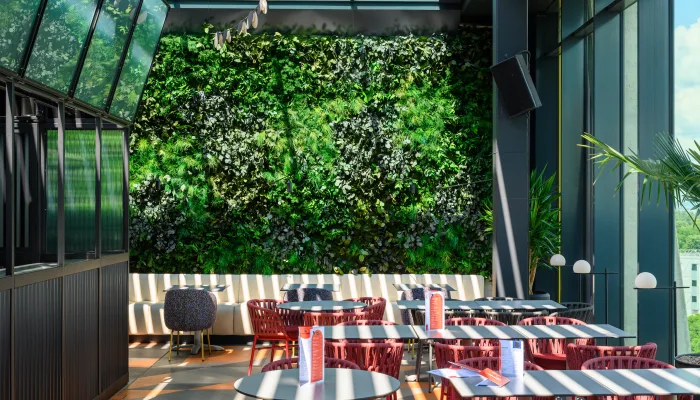
Moln IX Budapest
En flexibel coworking-yta på 4 000 m² med bevarade mossinstallationer överallt. Designen kombinerade Ball Moss-paneler med naturliga ekramar och Greenmoods Designkollektion produkter (Kaskad, G-cirkel). Noll underhåll var avgörande för en hyresfastighet där ansvaret för underhåll delas.
Vanliga frågor och svar
Renar bevarade mossväggar luften?
Nej. Konserverad mossa är biologiskt inert efter stabiliseringsprocessen med glycerin. Den fotosyntetiserar inte, absorberar inte CO2 och filtrerar inte VOC-ämnen. Däremot avger den inga allergener, inget pollen, inga mögelsvampar och inga VOC-utsläpp. Den är neutral ur ett luftkvalitetsperspektiv.
Är bevarade mossväggar säkra i händelse av brand?
Ja. Professionsmässiga bevarade mossväggar är brandtestade och certifierade. Greenmood Ball Moss har betyget B-S2-d0 enligt EN 13501-1 (europeisk standard) och FSI 0 / SDI 15 enligt ASTM E84 (amerikansk standard). Detta innebär begränsat bidrag till brandspridning, begränsad rökutveckling och inga flammande droppar. Mossan är självslocknande.
Kan bevarade mossväggar installeras i tak?
Ja. Bevarad mossa är lättviktig (3-5 kg/m²) och kan installeras i tak, hängande konstruktioner och panelsoffor utan strukturella förstärkningar. Produkter som Kaskad och Hoverlight är specifikt utformade för takmontering och kombinerar stabiliserad mossa med integrerad belysning och akustikabsorption.
Hur anger jag bevarade mossväggar för ett WELL- eller LEED-projekt?
Begär följande dokumentation från tillverkaren: akustikprovningsrapport (ISO 11654 eller ASTM C423), brandcertifikat (EN 13501-1 eller ASTM E84) samt data om VOC-utsläpp. Dokumentera installationsytan i förhållande till total vägg-/takarea. Inkludera i biofilistrategin (WELL Feature 88) och akustikbehandlingsplanen (WELL Feature 78).
Vad är NRC-klassificeringen för bevarade mossväggar?
Ball Moss uppnår NRC 0,73 vid provning enligt ISO 11654:1997. Detta innebär att den absorberar 73% av ljudenergin. Som jämförelse har en standard akustikundertakskiva vanligtvis ett NRC-värde på 0,55–0,70, och en vanlig gipsskiva har ett värde på cirka NRC 0,05.
Vad kostar bevarade mossväggar jämfört med levande väggar?
Installationskostnader för bevarade mossväggar ligger vanligtvis mellan 150-300 €/m², beroende på mosstyp och designkomplexitet. Levande väggar kostar 400-800 €/m² enbart för installation, plus löpande underhåll på 50-100 €/m² per år. Över 10 år kostar en bevarad mossvägg 5-11 gånger mindre än en motsvarande installation av en levande vägg.
Specifikationsresurser
- Bolmossa akustikpaneler — Produktspecifikation och NRC-data
- Korkplattor av Alain Gilles Produktspecifikation
- Designsamling Katalog — Hela sortimentet
- Brandsäkerhet och biofila material — EN 13501-1 och ASTM E84-data
- Akustik- och materialprestanda — ISO 11654 testdata
- Hur man specificerar biofila akustiska lösningar — 5-stegs ramverk för specifikation
- Hållbarhet & LEED v5 Certifieringsvägar
För projektspecifik teknisk assistans, kontakta din regionala Greenmood-representant eller mejla se@greenmood.se
 English
  Swedish