


Akustisk välbefinnande på den hybrida arbetsplatsen
Arkitektens guide till att anpassa kontor för fokus, videosamtal och mätbar akustisk komfort. Varför “akustiskt välbefinnande” har ersatt “öppna kontorslandskap” som den högsta företagsprioriteringen inom design, och hur konserverade mossa-paneler presterar bättre än konventionellt akustikskum på de mätvärden som har betydelse för WELL- och LEED-certifieringar.
Innehållsförteckning
Varför akustisk välfärd ersatte det öppna landskapet
Det öppna landskapet dödades inte av pandemin. Det dödades av videosamtalet. När en tredjedel av en given arbetsstyrka deltar i ett Zoom-, Teams- eller Google Meet-möte vid ett givet tillfälle slutar det öppna landskapets akustiska förutsättningar att fungera. Taluppfattbarheten kollapsar. Koncentration blir en privat resurs som de anställda bär med sig i sina hörlurar. Hörlurarna blir i sin tur ett tecken på att designen har misslyckats.
En panel av akustikexpert som sammankallats av International WELL Building Institute identifierade detta misslyckande direkt. När användningen av personlig skyddsutrustning, i form av brusreducerande hörlurar, blir standardiserad som hanteringsmekanism för kontorsarbetare har faran inte tagits bort. Den har överförts till individen. Hörlurar på hög volym skapar sitt eget hörselhälsoproblem. De isolerar arbetstagare från varandra. De är ett tecken på att byggnaden inte har gjort sitt jobb.
Uttrycket “akustisk välfärd” har dykt upp under 2024 och 2025 som det företagsvisa svaret på detta misslyckande. Det är mer än akustisk avskildhet. Det omfattar efterklangskontroll, taluppfattbarhet, kalibrering av ljudmaskering och integrationen av biofila ytor som absorberar mellanfrekvent ljud samtidigt som de stöder kognitiv återhämtning. Arbetsplatsstrateger på BuzziSpace, Soft dB och ekko Acoustics behandlar nu akustisk välfärd som en primär designfaktor, inte en eftertanke som hanteras med takplattor.
Skiftet är mätbart. Enligt en global undersökning som rapporterats av BuzziSpace uppger hälften av alla kontorsarbetare att en tystare miljö är den enskilt största bidragande faktorn till deras produktivitet, och drygt sjuttio procent tappar ofta koncentrationen under arbetsdagen. Fjärtiofyra procent uppger att deras arbetsgivare inte gör någonting åt saken. Samma undersökning identifierar kollegors samtal, telefonsamtal, ringande telefoner och rörelseljud som de största akustiska störningsmomenten på det postpandemiska kontoret.
Vad data om hybridkontor faktiskt säger
Hybridarbete är nu standardmodellen för europeiskt kunskapsarbete. Enligt Ciscos Global Hybrid Work Study 2025 arbetar femtiotrea procent av de anställda i Tyskland i en hybridlösning, och den europeiska frekvensen för återgång till kontoret ligger på ungefär sjuttiofem procent. Konsekvensen för kontorsutformningen är otvetydig. Byggnader används nu av en fluktuerande, delvis närvarande population en given dag, och det akustiska skalet måste fungera för såväl en nästan tom måndag som en fullsatt onsdag.
Soft dB-analysen av aktivitetsbaserat arbete fångar upp det resulterande designproblemet. En hektisk dag måste byggnaden klara av ljudtoppar från vardagliga samtal, videosamtal och rörelse i lokalerna. En tyst dag måste samma byggnad undvika den knäpptysta stämning som gör att medarbetarna känner sig övervakade av sina egna andetag. Statiska akustiklösningar som är utformade för det femdagarsservicekontoret klarar inte båda delarna.
Forskning som citerades i IWBI-panelen från University of California, Irvine, visade att kontorsarbetare avbryts så ofta att det kostar mätbar tid att återgå till ett tillstånd av djupt arbete efter varje avbrott. En separat studie som refererades av akustikingenjören Amanda Robinson visade att sextio procent av de brittiska kontorsarbetarna uppger att de inte kan koncentrera sig på grund av arbetsplatsens akustiska miljö. Koncentration är med andra ord inte längre en självklar egenskap på kontoret. Den måste designas in.

Den hybrida marknadskontexten
Den hybrida marknaden har expanderat snabbare än vad företagskommunikation vanligtvis antyder. Enligt JLL:s Global Workforce Survey integrerade tjugofem procent av de nya kontorsarbetsplatserna under 2024 dedikerade telefonbås och privata arbetsstationer utformade för fokuserat arbete. London, Singapore, Amsterdam, Paris, Dubai, Seoul och New York utökar alla sina ytor för flexkontor, där coworking och flexibla hyreskontrakt nu utgör en betydande del av nettotillväxten av nya kontorsytor på de flesta stora marknader.
En studie från 2025 av Leesman, som omfattar mer än fyrtio länder, visade att nästan nittio procent av deltagarna anser att social kontakt är en mycket viktig del av kontorslivet. Det moderna kontoret är inte längre i första hand en plats för fokuserat enskilt arbete. Det arbetet har flyttat hem. Kontoret har blivit en social infrastruktur, och det akustiska höljet för denna infrastruktur måste stödja både spontana samtal och videopresentationer med höga insatser, ofta inom samma timme och i samma siktlinje.
Den globala specifikationsmarknaden har svarat med att uppgradera akustisk prestanda från en ytfinish till ett primärt beställningskriterium. Hållbarhets- och hälsomässigt fokuserade byggnader, som prioriterar luftkvalitet, bullerdämpning och optimal belysning, definierar nu det övre skiktet av marknaden för flexibla kontor världen över. Mässorna Workspace Design Show, NeoCon och Orgatec under 2025 bekräftade samma mönster: varje större kontorsmöbeltillverkare har flyttat fram sina akustiska anspråk till början av sin produktkommunikation.
Akustikskum versus konserverad mossa: en direkt jämförelse
Standardytan för akustik på kommersiella kontor är fortfarande akustikskum, vanligtvis melaminbaserat, tygklätt eller monterat som hängande bafflar. Konserverad mossa jämförs sällan med skum vid specifikation för arbetsplatser, vilket är precis därför jämförelsen är viktig.
Siffrorna, sida vid sida:
| Metrisk | Akustikskum (1 tum) | Akustikskum (2 tum) | Greenmood Bollmossa |
|---|---|---|---|
| NRC (typiskt publicerat intervall) | 0.40 | 0,65 till 0,85 | 0.73 |
| Teststandard | ASTM C423 | ASTM C423 | ISO 11654:1997 |
| Mellonstrupsabsorption (500 till 2000 Hz) | Måttlig | Stark | Stark |
| Brandklass | Variabel, ofta flamskyddsbehandlad melamin | Variabel | B-s2,d0 (EN 13501-1) och FSI 0 / SDI 15 (ASTM E84) |
| Visuell läsning | Industriell, ofta dold bakom tyg | Industriell, ofta dold bakom tyg | Naturlig struktur, biofilisk |
| Underhåll | Ingen till dammborttagning | Ingen till dammborttagning | Ingen |
| Slut på livslängden | Petrokemiskt avfall | Petrokemiskt avfall | Komposterbar |
| WELL-funktion 88 (Biofili) poäng | Bidrar inte | Bidrar inte | Bidrar direkt |
En 1-tums skumpanel reflekterar ungefär sextio procent av den ljudenergi som träffar den. En 2-tums skumpanel presterar bättre men kräver vanligtvis tygklädsel för brandklassning och visuellt godkännande i färdiga kontor. Greenmood Ball Moss, testad enligt den europeiska standarden ISO 11654:1997, uppnår NRC 0,73, i samma intervall som en exklusiv tygklädd glasfiberpanel, samtidigt som den levererar det biofila värde som skum inte kan erbjuda.
Skumgummi vinner på råkostnad per kvadratmeter. Konserverad mossa vinner på alla andra områden som en arkitekt specificerar: dokumentation av brandklass, bidrag till biofilipoäng, inomhusluftens neutralitet, egenskaper vid livscykelns slut och ytans visuella intryck i en färdig interiör.

Konserverad mossa som biofilisk akustisk infrastruktur
Konserverad mossa är ett biologiskt material vars naturliga fukt har ersatts genom en glycerinstabiliseringsprocess. Resultatet är mossa som behåller sin färg, struktur och mjukhet på obestämd tid, utan bevattning, belysning eller biologisk aktivitet. Den växer inte. Den frigör inga sporer. Den bryts inte ned. Och, vilket är avgörande för akustisk specifikation, absorberar dess tredimensionella ytstruktur ljud över samma mellanfrekvensområde som det mänskliga talet upptar.
Greenmoods sortiment av konserverad mossa omfattar fyra primära arter, var och en med distinkta akustiska och visuella egenskaper.
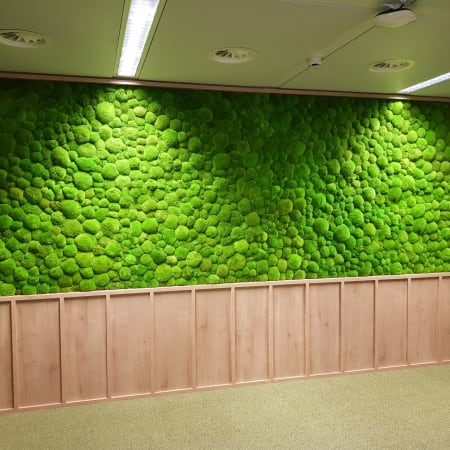
Tät, kudkliknande textur. Den mest högpresterande akustiska mossa i sortimentet, testad till NRC 0,73 enligt ISO 11654. Standardvalet för akustik vid renovering av hybridkontor.

Mjukare, mer enhetlig yta som finns i flera färger. Specificerad för stora logoväggar, varumärkesytor och projekt där den visuella upplevelsen är viktigare än det absoluta NRC-värdet.

Vild, naturalistisk yta som kombinerar flera mosstexturer. Avsedd för projekt där ett mer texturerat, mindre tillrättalagt biofilt uttryck efterfrågas.
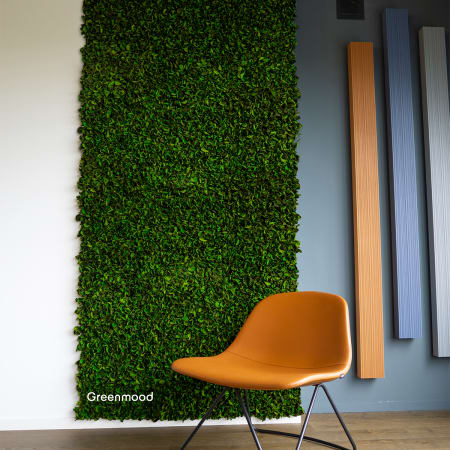
Upplevs som en platt, frodig, trädgårdsliknande yta. Specificeras oftare för hotell- och restaurangverksamhet samt exklusiva bostäder än för företagskontor.
The Greenmood Designkollektion utvidgar samma akustiska logik till tak- och belysningsprodukter. Hoverlight integrerar konserverad mossa i en hängande armatur som absorberar takreflektioner. Kaskad levererar takmonterade mossa-paneler som fungerar som akustikabsorbenter ovanför öppna möteszoner. G-cirkel fungerar som en fristående biofil avdelare med akustiskt värde i övergångsutrymmen. Ingen av dessa produkter kräver vatten, annan elinfrastruktur än belysningen i Hoverlight eller strukturell förstärkning.
NRC, certifiering och specifikationsvägen
För arkitekter som arbetar med WELL- och LEED-projekt är specifikationen av akustiska mossa-paneler inte ett estetiskt val. Det är en dokumentationsfråga. De poäng som biofila akustiska ytor stöder är konkreta och väl definierade.
Kreditet kräver att målen för efterklangstid uppfylls i definierade utrymmestyper. Bollmossa med NRC 0,73, testad enligt ISO 11654, genererar dokumentation som direkt bidrar till beräkningar av efterklangstid. Akustikskum kan göra samma sak, men skum uppfyller inte dessutom Funktion 88.
Krediten kräver integrering av natur i interiören, utan att göra någon skillnad mellan levande och konserverade biofila element. Konserverad mossa räknas. Skumgummi gör det inte.
Konserverade mossa-väggar avger inga VOC:er, ingen formaldehyd och inga partiklar. De bidrar positivt till inomhusmiljöns kvalitet och uppfyller kraven under mönstret “natur i utrymmet” i kreditfamiljen Occupant Experience.
Greenmood Ball Moss har en B-S2-d0-klassificering enligt EN 13501-1 (den europeiska brandklassstandarden) och FSI 0 / SDI 15 enligt ASTM E84, där den senare uppfyller kraven för invändig ytbeklädnad i klass A i USA. Denna dokumentation möjliggör specifikation i kommersiella interiörer på DACH-marknaden och i Nordamerika utan kompletterande brandskyddsbehandling.
Specifikationsdokumentationspaketet som en arkitekt bör begära från en leverantör av konserverad mossa för en tysk företagsrenovering inkluderar det akustiska testrapporten enligt ISO 11654, brandtestcertifikatet enligt EN 13501-1, en VOC-emissionsrapport eller försäkran om överensstämmelse, samt en deklaration om glycerinstabiliseringsprocessen och dess växtbaserade, livsmedelsgodkända ursprung. Greenmood publicerar alla fyra.

Var mossa-paneler hör hemma i ett hybridbjälklag
Planlösningen för det hybridanpassade kontoret är inte längre ett enda öppet utrymme. Den är en portfölj av akustiska zoner, var och en med sitt eget designprogram.
Telefonkiosker och fokusrum
Den enskilt mest effektiva tillämpningen för biofila akustiska ytor. En telefonkoll huva klädd med paneler av bollmossa ger den akustiska dämpning som behövs för tydlig talöverföring vid videosamtal, samtidigt som ytornas textur minskar den klaustrofobiska känsla som bås med enbart skumplast ger upphov till. Användaren kliver in i ett litet utrymme som låter lugnt och ser levande ut, inte i en isoleringscell.
Mötesrum
Rum som är utformade för videopresentationer och hybridmöten drar nytta av akustiska ytor på minst två icke-parallella väggar. Konserverade mossa-paneler i kombination med akustikplattor av kork skapar en efterklangsprofil som stöder både mikrofonklarhet för på distans anslutna deltagare och samtal i mänsklig skala för deltagare i rummet.
Öppna samarbetszoner
Större, mer utspridda utrymmen där team samlas för korta, informella utbyten. Takarmaturer av typen Hoverlight och Cascade-paneler ger akustisk absorption uppifrån utan att ta upp väggyta, vilket bevarar zonens öppenhet samtidigt som efterklangen kontrolleras.
Tysta zoner och biblioteksnischer
Den hybrida motsvarigheten till hemmakontoret. Utrymmen utformade for individuellt djuparbete, med hög akustisk absorption och visuella signaler som markerar “stör ej”. En fondvägg av klotmossa i en bibliotekshörna fyller båda funktionerna samtidigt.
Reception och utlåning
Första intrycks-ytor där besökarens uppfattning om varumärket sätts på de första tio sekunderna. Konserverad mossa i receptionen kommunicerar hållbarhet, designmedvetenhet och ett trovärdigt engagemang för välbefinnande, utan underhållsansvaret för en levande vägg i ett högtrafikerat område.

Hur manspecificerar för en företagsanpassad hybridanpassning
En ombyggnad till hybridkontor går från konceptdesign via anbud till installation i ett stramare regel- och upphandlingssammanhang än nybyggnation. Specificering av konserverad mossa för dessa projekt gynnas av några praktiska överväganden.
Specificera efter akustisk prestanda, inte efter estetik. Anbudet kommer att utvärderas utifrån dokumenterade NRC-värden och brandklassning innan det utvärderas utifrån visuellt resultat. Led med NRC 0,73 (ISO 11654:1997) för Ball Moss och relevant brandklass: B-s2,d0 enligt EN 13501-1 för europeiska projekt, FSI 0 / SDI 15 enligt ASTM E84 (Klass A) för nordamerikanska projekt. Bifoga provningsrapporterna som bilagor.
Matcha mossarten till zonen. Bollmossa för akustikzoner med höga krav (telefonhytter, exklusiva mötesrum, fokusrum). Renmossa för varumärkesstarka installationer och storskaliga logotyper. Hoverlight och Cascade för takakustik i öppna zoner.
Samordna med WELL- eller LEED-konsulten tidigt. De akustiska och biofila poängkrediterna korshänvisar till varandra. En enda specifikation av bollmossa uppfyller både funktion 78 och funktion 88 i WELL v2, och en samordnad inlaga förbättrar projektets totala poäng utan ytterligare produktspecifikation.
Plan för installation i bebodda byggnader. Konserverade mossa-paneler väger 3 till 5 kg per kvadratmeter, installeras på en enda dag för en yta på 20 kvadratmeter och kräver inget vatten, ingen elanslutning och ingen strukturell bedömning. För alla renoveringar där störningar för de boende är ett avtalsmässigt problem är detta avgörande.
Samordna regionalt stöd. Greenmood bedriver direktförsäljning från sitt huvudkontor i Belgien över hela Europa, med ett nordamerikanskt team för projekt i USA och Kanada, samt regionala partner i Mellanöstern, Asien och Oceanien. Fullständig teknisk dokumentation, testrapporter enligt EN- och ASTM-standard samt på-platsen-specifikationsstöd finns tillgängliga på projektets regionala språk.

Vanliga frågor och svar
Vad har Greenmood Ball Moss för NRC-klassificering?
Kulmossa har testats enligt NRC 0,73 i enlighet med ISO 11654:1997. Detta motsvarar 73% av den infallande ljudenergin som absorberas av ytan. Som jämförelse har en standardakustikplatta ett NRC-värde mellan 0,55 och 0,70, en 1-tums akustikskumpanel har ett NRC-värde på cirka 0,40 och en bar gipsskiva har ett NRC-värde på cirka 0,05.
Bidrar konserverad mossa till WELL v2 akustikkrediter?
Ja. Konserverade mossa-paneler bidrar direkt till WELL-funktion 78 (Ljud – Akustisk komfort) genom uppmätt NRC-absorption som stödjer efterklangstidsmål. De bidrar också till funktion 88 (Sinne – Biofili) under kravet på naturinförlivande i inredningsdesign. Ingen skillnad görs i WELL v2 mellan levande och konserverade biofila element.
Uppfyller konserverad mossa Tysklands brandskyddsregler för kontor?
Greenmood Ball Moss har klassificeringen B-S2-d0 enligt EN 13501-1, den europeiska brandklassificeringsstandarden som har antagits i hela Tyskland. Denna klassificering tillåter specifikation i de flesta typer av kommersiella byggnader i Tyskland utan ytterligare brandskyddsåtgärder. Fullständiga testrapporter finns tillgängliga på begäran.
Hur står sig konserverad mossa jämfört med akustikskum för anpassningar av hybridkontor?
Konserverad mossa matchar eller överträffar NRC-prestandan hos akustisk skumpanel med medeltjocklek, samtidigt som den bidrar till biofilipoäng, inte avger några VOC-ämnen och utgör en färdig biofil yta som inte kräver tygomslutning. Akustisk skum vinner på råkostnad per kvadratmeter. Konserverad mossa vinner på alla andra specifikationskriterier.
Kan konserverad mossa installeras i telefonhyttar och fokusrum?
Ja. Telefonhyttar och fokusrum är den enskilt mest effektiva tillämpningen för konserverad mossa i en hybridrenovering. Den akustiska absorptionen stöder tydlig talöverföring vid videosamtal, och den naturliga strukturen minskar den visuella klaustrofobin hos interiörer som enbart består av skum.
Hur länge håller konserverade mossa-paneler?
Greenmood konserverade mossa-paneler har 10 års garanti. Vid korrekt inomhusinstallation, i skydd från direkt solljus och överdriven luftfuktighet, bibehåller panelerna vanligtvis sitt utseende i 10 år eller mer utan åtgärd. Många installationer förblir visuellt oförändrade efter 15 år.
Kräver den tyska marknaden ytterligare dokumentation?
Greenmood tillhandahåller all standarddokumentation på tyska för DACH-marknaden, inklusive akustiktestrapporten enligt ISO 11654, brandprovningscertifikatet enligt EN 13501-1, VOC-försäkran om överensstämmelse och det tekniska databladet för varje produktlinje. Projektspecifik dokumentation, inklusive skräddarsydda installationsritningar, finns tillgänglig på begäran.
Specifikationsresurser
- Bolmossa akustikpaneler — Produktspecifikation för NRC 0,73
- Korkplattor av Alain Gilles — Specifikation för akustisk kork
- Designkollektion — Hela sortimentet inklusive Hoverlight, Cascade, G-Circle
- Hoverlight — Upphängd biofil armatur med akustisk absorption
- Akustik- och materialprestanda — ISO 11654 testdata
- Brandsäkerhet och biofila material — EN 13501-1- och ASTM E84-dokumentation
- Hållbarhet & LEED v5 Certifieringsvägar
- Hur man specificerar biofila akustiska lösningar – 5-stegsramverk
För projektspecifik teknisk assistans, kontakta din regionala Greenmood-representant eller mejla us@greenmood.us.
 English
  Swedish